Try to make connections, and “converse” with the authors in your margins. Keep a running list of any new questions or “open loops” that arise as you read.
Methods for Note taking
Cornell Method
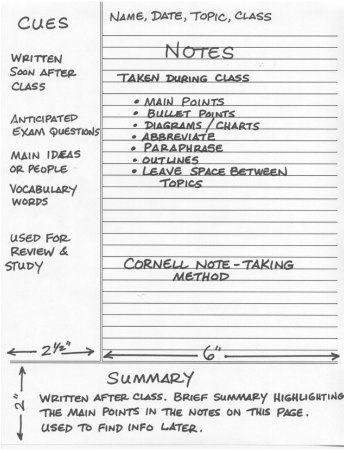
Highly organized, simple and efficient for recording/reviewing notes. This method encourages active summarizing and intentional focus, ensuring the note taker processes key points rather than just transcribing. It also makes notes revision ready as the left column tests knowledge and the bottom section reviews memory.
Outline Method

A highly structured, visually illustrated hierarchy of ideas that can be taken at a glance. Records content and relationships, reduces edit time and is easy to review Disadvantage: requires significant thought to accurately organize points (bad for fast lectures). Doesn’t show relationships by sequence and is not recommended for topics that have a visual aid (charts, diagrams, etc)
Mind Mapping

Mapping provides a dynamic visual overview that simplifies complex information, boosts memory retention through visual cues, and highlights the relationships between interconnected topics. It encourages active participation and critical thinking, while allowing you to visually track a heavy lecture with relatively little thought once started. Disadvantages: The visual nature makes it less effective for capturing detailed, linear facts, and maps can easily become complex or unwieldy for dense subjects. Additionally, creating the map demands high concentration and can be time-consuming, potentially distracting you from the actual learning material.
Charting Method

By organizing data into columns and rows, charting allows for the minimalistic recording of information and makes it incredibly easy to compare and contrast facts across multiple sources. It reduces review time, enables quick information retrieval, and is ideal for fast-paced, dense content or creating a single-page overview of an entire course. Disadvantages: This method requires a time-intensive setup, as you must identify your categories and prepare your columns before note-taking begins. Because of this, it lacks flexibility for unstructured talks or unexpected topics, and it is not suitable for STEM subjects requiring formulas or graphs.
The Sentence Method Advantages: Writing each new thought as a separate, numbered sentence is simple, straightforward, and requires no preparation. It allows you to capture most or all of the information quickly, and using whole sentences creates a logical narrative structure for your notes. Disadvantages: The linear format makes it difficult to distinguish between major and minor points, meaning notes are hard to edit or review unless you completely rewrite and cluster the related points. It also demands fast typing or writing skills, which can result in an overwhelming volume of notes and detract from active listening and comprehension.