This case study was performed over a 10 week period with a group consisting of Adeeba Ahmad, Victor Lara, Ettie Mikhailova, and Eric Drake.
“Design a holistic car purchasing process that addresses pain points along the entire end user journey. This case study can use speculative design systems (such as AR), but must explain its applicability and purpose.”
1. Understanding our primary demographics
Our initial meeting consisted of mapping our biases through an assumption grid as well as devising a series of user empathy maps in order to create a preliminary picture for our ‘buyer’ and ‘seller’ groups we could reference.
Discovering user pain points and characteristics
Following this introductory stage, we moved into our first research stage. We began by collecting qualitative data about our demographics through user interviews. Our interviewees were picked based on whether they had bought a car in person, online or were a prospective buyer doing research for a purchase. We were able to conduct 16 interviews and mapped their response onto corresponding journey maps to visualize their experiences with car shopping. Our qualitative research brought us some takeaways:
- Most buyers begin their car search online because they want to shop their initial car choice around.
- Remote work and current supply makes car purchasing a lower necessity for some (particularly with EV vehicles).
- Paperwork and financing confuses buyers who are unfamiliar with materials needed.
- Finding the best deal on a car (instead of purchasing their top choice) is a buyer’s top priority. For many, there is some flexibility with car choices based on pricing.
Press enter or click to view image in full size
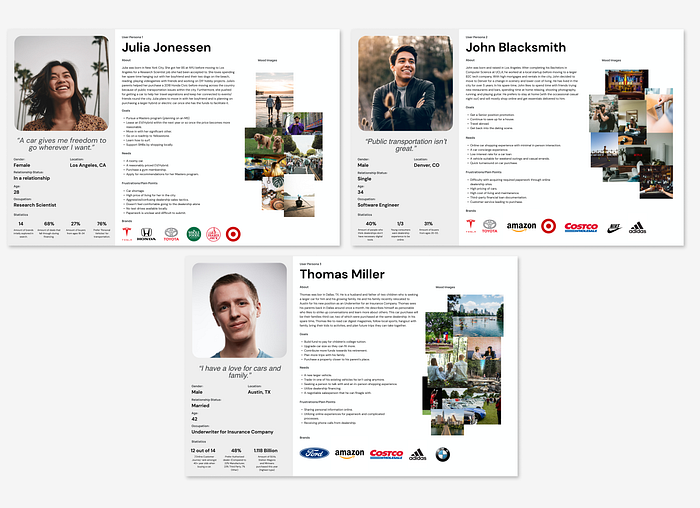
User Persona based on our first round of interviews and separated by age range. Mapping exercises like these are essential for refamiliarizing and realigning with our user’s pain points, goals and overall characteristics.
Roadblock 1: Converging too quickly
After conducting our initial interviews, the group began synthesizing responses into towards a Problem Statement. However, we discovered that this premature convergence would limit our brainstorming as it didn’t take in the whole scope of our research. With this in mind, we tabled the Statement refining until we could complete our preparatory and secondary research stages.
Gathering more information and mapping online findings
Using our preparatory research, we created a System Map to embody the relationship of all stakeholders in our projects scope. We also created an initial dealership System Blueprint based on the gathered research that aimed to map the relationship not only of customer facing interactions, but of back end processes and the stakeholders involved at each step. The goal for both exercises were to understand the current state of the dealership system and provide a reference as we continued to learn. We also conducted secondary research online focused on understanding the current car market, the customer buying experience, and devise a competitive analysis of other adjacent companies. These were our main takeaways from the quantitative stage of research:
- There is a growing desire to purchase a car, but there isn’t a sufficient supply.
- Current buyers are paying significantly more than average for new/used cars.
- Consumers are anxious about being taken advantage of during the finance process.
- Dealerships lack an online experience for consumers despite demand.
- When researching, users will visit multiple sites before visiting dealerships.
Press enter or click to view image in full size
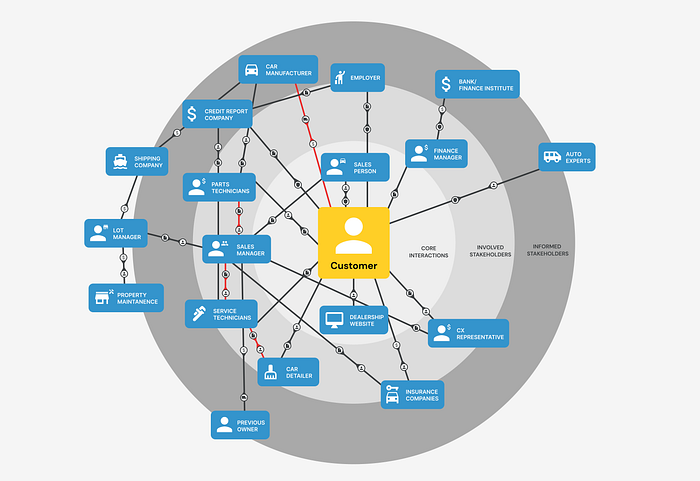
System Map detailing the different stakeholders and the mutual links (materials, energy, information, money, documents..) occurring around the customer purchasing process. The research surrounding this model was helpful in informing our group on the current state of the dealership system and the stakeholders our primary demographics will be touching base with.
2. Defining the issue(s) to address
During this stage, we began our “How might we” statements again. Starting now with more data, we synthesized our findings into five areas that we thought needed the most attention when addressing the car purchasing process.
How might we…
Meet demand for online experience?
Users reported a dissatisfaction with current online offerings connected with dealerships.
Streamline the financing process so it is more approachable for first time and returning customers?
When tracking customer drop off rate, the financing of the car is where most customers quit their purchase (68% according to Forbes).
Combine the research and dealer communications processes?
Third party business management firms stall the process of communication and can lead to further distrust with customers when handling their private data.
Update the in person experience to facilitate better interactions between dealership and customer?
Customer data from our user interviews and across three different crowd sourced review sites (Reddit, Yelp and Google Reviews) showed a distinct correlation with easier navigation and friendliness of a dealership layout to referrals and purchases.
Alleviate consumer anxiety with more transparency on how we handle their data?
Outside of getting a bad deal on a car, the handling of private financial and personal information was the most anxiety inducing facet of car purchasing for consumers (source)
After distilling our findings into these statements, we further specified a POV statement that our group would use to approach with our next of development.
“Customers need a comprehensive online database and communication system because the current dealership purchasing pipeline is convoluted and complicated.”
3. Brainstorming new approaches to the dealership experience
Before moving into design sprints, the team convened to distill areas of focus for our ideation process and reorient to our HMW/POV statement(s).
- Online presence is lacking for those wanting hybrid or completely digital options.
- Organization of documents is disjointed and unclear.
- Learning curve is too steep.
- Time loss due to customer confusion or dealership upselling.
With this in mind, we moved in a series of sprints. We split up ideation into 8 different team exercises where we imagined possible solutions, critiqued each others concepts and dot-voted on the best ones to build out further. The goal was to diverge conceptually on what solutions could address our users’ pain points before converging on ideas to prototype.
After a couple of days, we had a list of emerging ideas. We then whittled down that list into 5 solutions to building out:
- Online Education Module System
- Dealership Open Module Architectural Layout
- “Build Your Car” Comparison tool
- Integrated Car Research tool with the dealership site
- Online Dealership Profile Ecosystem
4. Testing our solutions for digital and physical experiences
Before breaking into groups, we decided as a team on what deliverables we wanted to work on through our development stage. The digital team would complete site mapping, paper prototypes/sketches, and wire-framing for devices. The physical team would deal with diagramming, spatial planning, mapping customer touch points and creating a 3D model of a proposed dealership space.
We scheduled meetings in between our development days to present the work, critique our designs, and ideate better ways to integrate digital and physical prototypes into our future-state customer journey.
Press enter or click to view image in full size
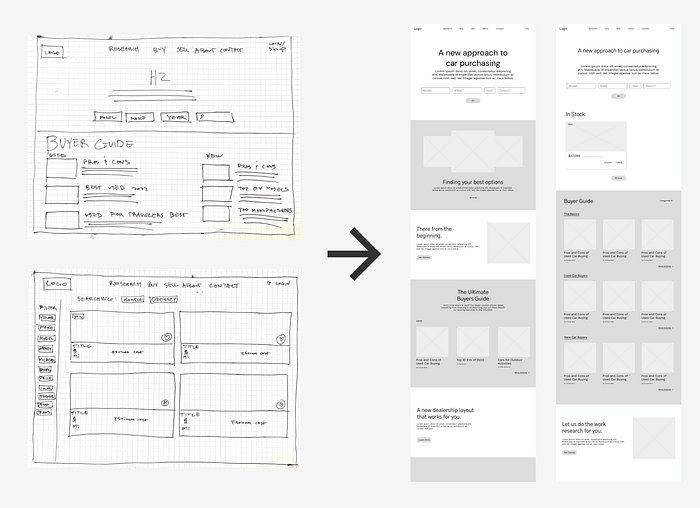
Lo-Fi to Mid-Fi design transition, turning our sketches into clickthrough prototypes for testing.
Press enter or click to view image in full size
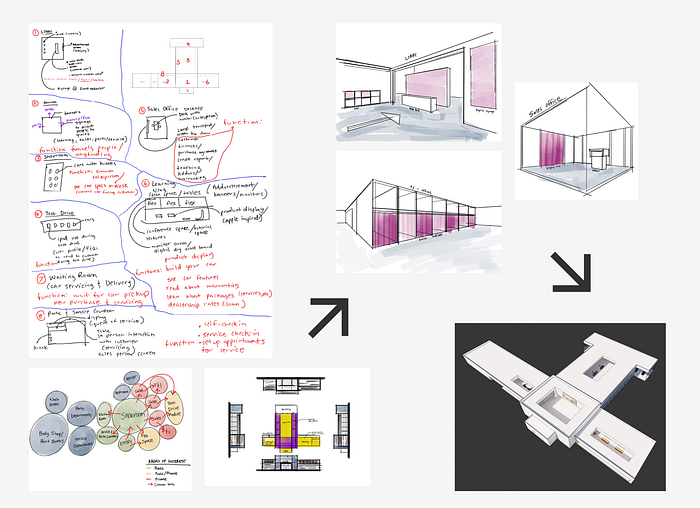
Ideation and design for an architectural space that could facilitate a more productive, comfortable experience.
Roadblock 2: Growing pains when connecting digital and physical experiences
Planning the display of customer profile information across tablets, kiosks and LCDs proved to be a tough task when thinking of the back end functionality. Consulting with our dealership interviewees again, we found that dealerships utilized Customer Relationship Software to communicate when working with customers. With this in mind, we developed a clickthrough CRM system to integrate with our dealership space. This new system simplified how dealers could share information with customers along their purchasing experience in person or digitally through their profile.
Press enter or click to view image in full size
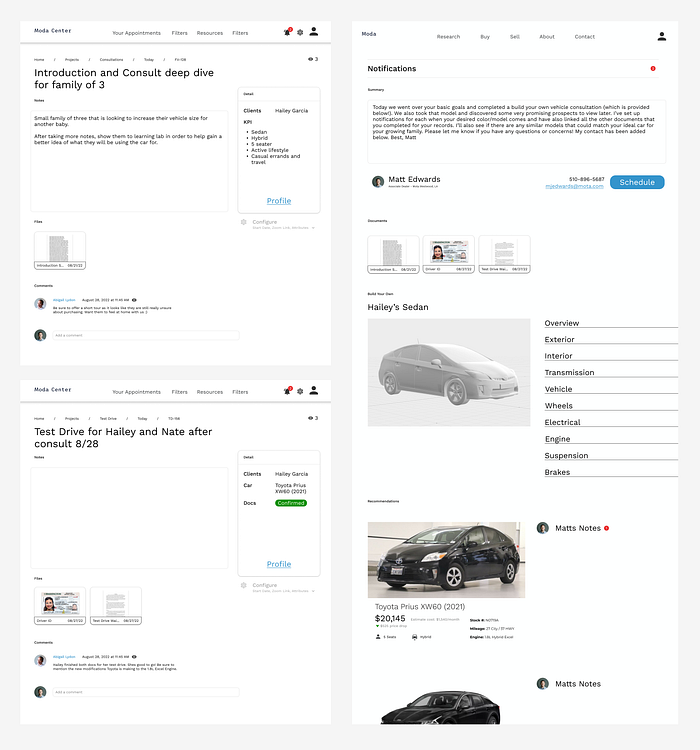
Dealership Customer Relationship Software tablet screens. (On left) (top) Dealer-customer introduction notes with customer paperwork attached (bottom) Test drive with driver ID attachment. (On right) Customer visit breakdown on their profile with Dealer specification suggestions, customer document attachments, and dealer car recommendations.
Our solution
Our holistic car dealership solution, Moda, aims to simplify the car purchasing and post purchase experience for customers and dealers. Customers dictate the experience and we supply them with all the tools necessary to acquire the car they want.
Press enter or click to view image in full size
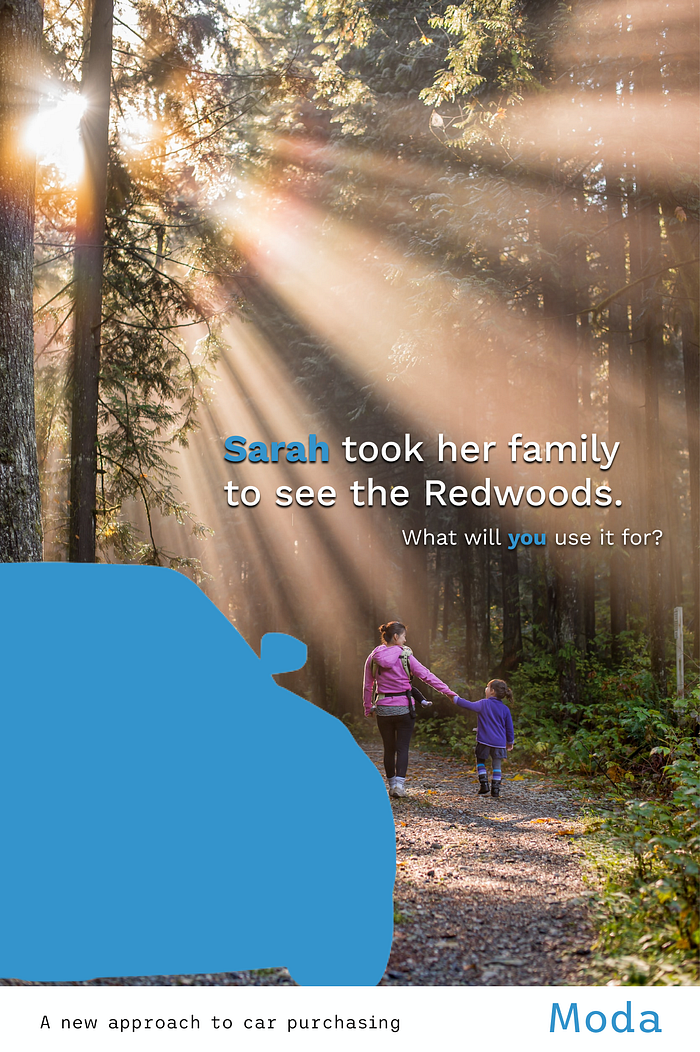
Branding Asset
1. Customer Research
Our “Build Your Own Car” tool, customer article feed and car comparison tools allow users to discover information about possible leads, save their favorites and then organize that information in their profile for future reference.
Press enter or click to view image in full size
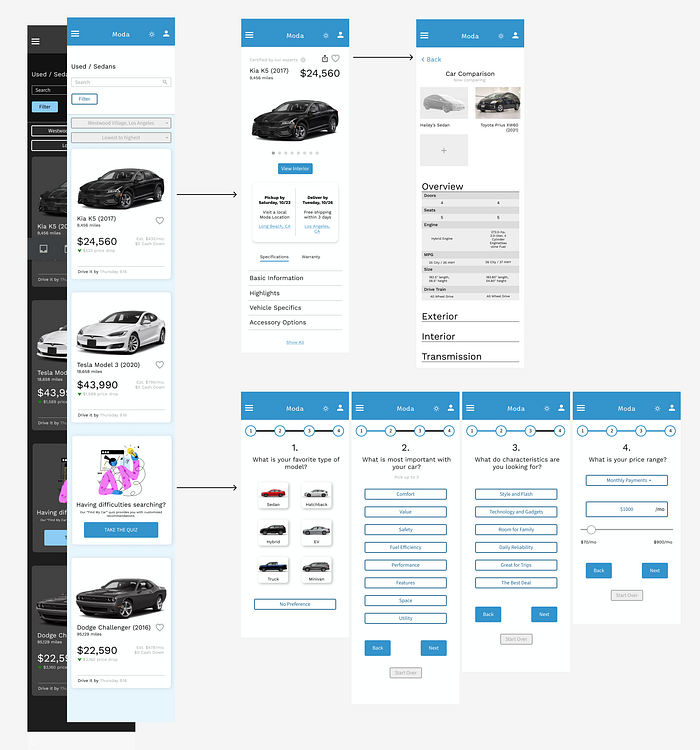
Mobile purchasing main page including car search quiz, Product page, and car comparison tool.
Press enter or click to view image in full size
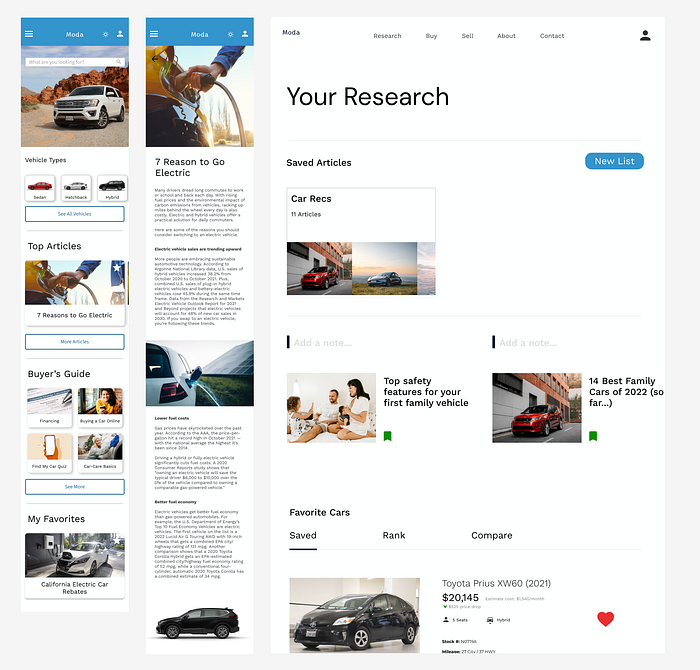
Articles section (left) and research save page (right). Allows customers to browse categories , organize saved articles in to lists and take notes on their favorites.
2. Contacting Dealership/Planning
We offer a completely online approach that allows users to move through organized modules at their own pace. Additionally, users can order test drives at home, submit files securely through the online portal and chat with dealers on video calls or online chats.
Press enter or click to view image in full size
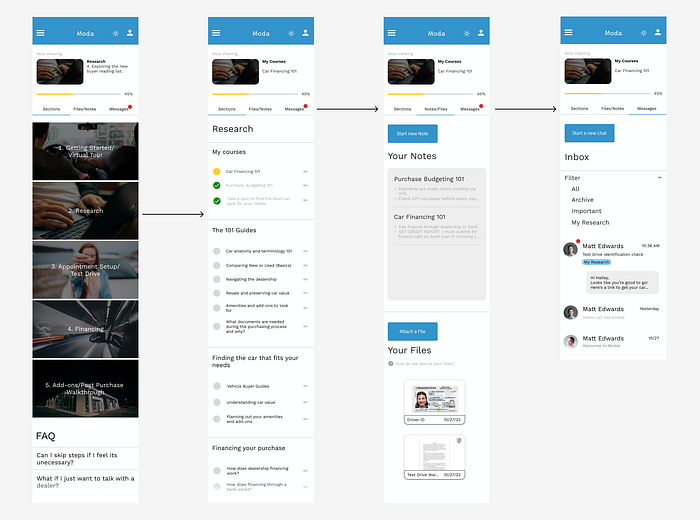
Online Learning Platform (left to right) Main page, modules, Notes/File section and Messaging. Gives customers a comprehensive, guided alternative if they want to complete their purchase partially or completely online.
3. Visiting the Dealership
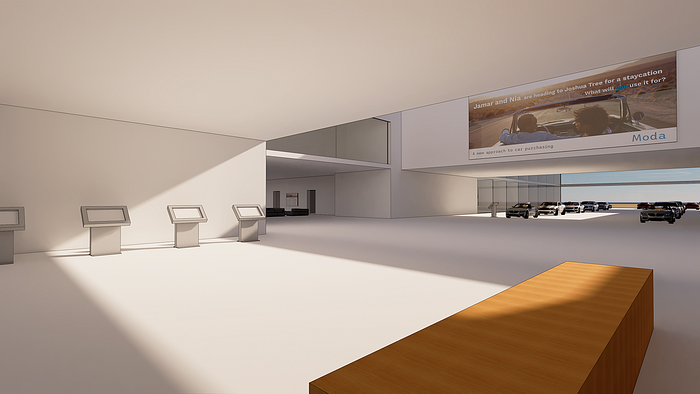
For those wanting an in person experience, we have Moda Centers. These dealerships consist of four distinct areas.
- Reception Bay: Once they have arrived, customers can set up or find their appointment reservation via the kiosks. All your profile information, including car preferences and personal documentation, will be sent to the Dealer’s CRM for speedier process.
Press enter or click to view image in full size
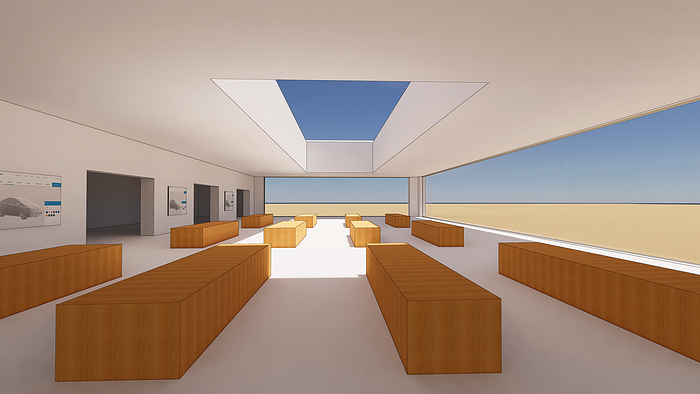
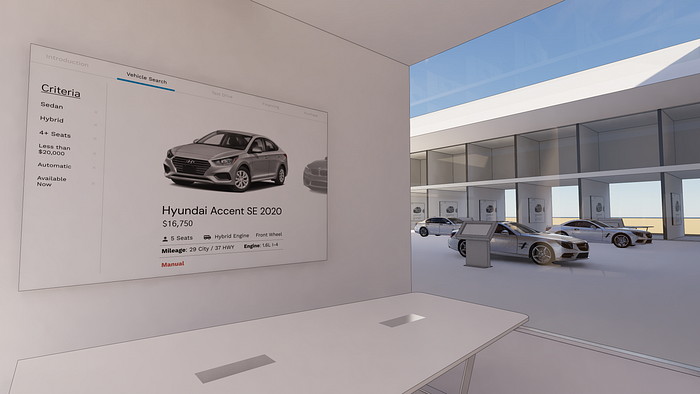
- The Custom Car Bar: Dealers can walk customers through the process of finding a car that fits their needs. Comes equipped with a real time 3D rendering application that can save customer creations to their profile for reference later.
Press enter or click to view image in full size
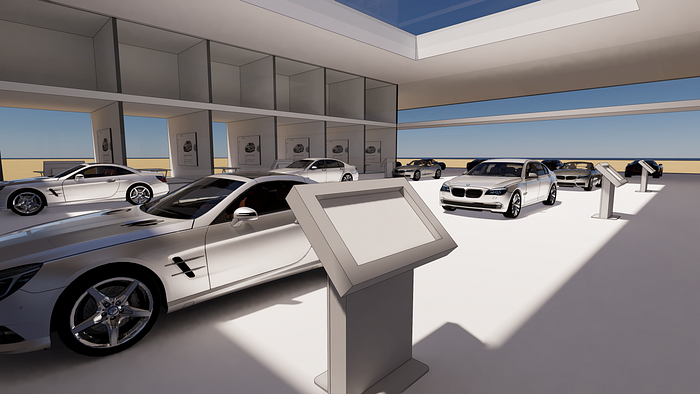
- The Showroom: When customers are ready to test drive and have provided the necessary documentation, the dealer can order the cars to be dropped off in the showroom.
Press enter or click to view image in full size
- Office Modules: Each dealer has their own office that comes equipped with a digital whiteboard. Customers can collaborate with dealers on their purchasing journey, favorite cars, and documentation via notes and comments that will be saved to their profile.
Press enter or click to view image in full size
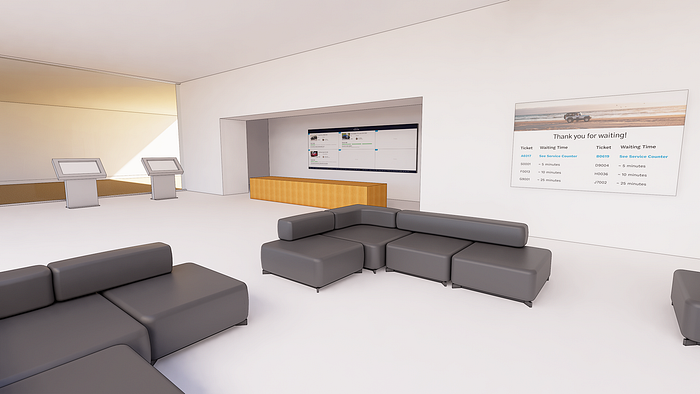
- The Maintenance Wing: Returning customers can drop off cars with our mechanics and receive notifications on the status of their vehicle. Additionally, all information regarding the appointment will be entered into the customer profile as a digital receipt.
Press enter or click to view image in full size
Looking towards next steps and final reflections on our project
Building out the post purchase experience
Outside of car maintenance, the group discussed a discounting system for car accessories, custom gift cards on customer’s birthdays, and streamlining the notifications system for reminders. All these ideas aim to make customers view Moda car dealerships less as a middle man to getting a vehicle, but as an advocate for their long term car goals.
Further user testing
With our first prototype complete, we would also like to circle back and test our ideas further. For the dealers, we would like to test if our IoT/CRM systems could be a viable tool when helping their selling process. For customers, we want to A/B test the module learning and research system to further understand how we can improve the usability and heuristics of the app.
Focusing more heavily on security
We laid the foundation for our profile and documentation system, but have not done enough research into how we can provide the best security options for our user base’s information. Exploring how tools such as 2-factor, encryption and microcopy can positively effect user anxiety over sharing sensitive documents is a must moving forward.